Years ago, I spent a lot of time working on a project for a major river system in Eastern Utah. It was a massive puzzle. We were trying to balance scarce water for a huge range of needs: farmers looking for irrigation, ecosystems needing instream flows, growing towns, and new industrial demands for oil shale.
Because everyone had a different priority, we spent endless hours in meetings discussing management scenarios. I built a model to provide a visual framework so everyone could actually see the impact of their choices. Some people wanted more storage, while others pushed for water rights transfers or conservation plans. The model had to respect the complex legal rules for everyone involved, from Tribal nations and environmental agencies to industry and local municipalities.
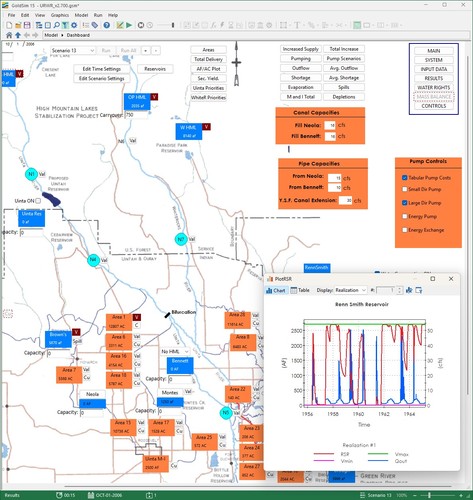
The "Gatekeeper" Bottleneck
The logic for this wasn't built from scratch. It was based on decades of complex math originally written in FORTRAN by the Utah Division of Water Resources. One of the biggest challenges was making sure the model could iterate through all those different water rights to get the daily allotments right.
In a system like this, the results are often non-intuitive. If you add a new reservoir or change a diversion capacity, it can have weird, cascading effects on return flows miles away.
I used GoldSim to take that old logic and wrap it in a dashboard that actually made sense in a room full of stakeholders. I remember sitting in a conference room with the model projected on a big screen. People would pepper me with questions like, "What if we raise the dam by five feet?" or "What if the oil company pays for this improvement so we can keep the high quality mountain water for the town?"
It was powerful to click a button and re-run the model right there. But I soon realized I was the only person who could drive the machine. I was the gatekeeper.
Breaking Down the Barriers
I started wondering what would happen if the stakeholders could make those changes themselves. I could give them a "Player" version of the model to take home, but that still meant they had to install software and manage files on their own machines.
I knew there had to be a better way. If I could host the model on the web with a controlled dashboard, I could reach more people. They could explore their own ideas on their own time and then come to the next meeting way more informed.
That is exactly what I have been building. We can now take a GoldSim model and host it on a server so multiple people can run simulations at the same time. No more gatekeeper and no more version control nightmares where everyone has a different file saved on their desktop.
How it works: High-Performance Simulations in the Cloud
Taking a sophisticated model and making it work in a browser requires a robust backend. My goal was to ensure that the experience remains fast and reliable even when multiple people are running simulations at the same time. Here is a look at the system I built to support this:
-
Cloud-based Computing: Instead of asking your laptop to do the work, the simulations run on specialized servers. These are built for math, so they process complex scenarios much faster than a standard office PC.
-
Handling the Crowd: I built a management system so the site stays fast even if several people are running models at once. If three different users hit "run" at the same moment, the system handles those calculations in the background without anyone feeling a lag.
-
A Tailored Interface: I build a custom front end that acts as the bridge. You move a slider or change a number, the cloud engine does the math, and the results come back instantly as clear, interactive charts.
Benefits of Web-Enabled Simulations
This approach lets the desktop software do what it does best (engineering) and the web do what it does best (communication). When we make models accessible online, we see a few big wins:
-
Real Interaction: A client can move a slider and see exactly how climate scenarios or irrigation demands change their world. It turns a boring, static report into a real exploration.
-
Model Integrity: You stay in control of the logic. You decide which variables people can play with, making sure the "what-if" scenarios stay within the realm of reality.
-
Building Trust: When people can touch the data themselves, the "black box" disappears. It stops being a mysterious calculation in an appendix and becomes a tool that helps everyone understand the trade-offs.
Whether it is a stochastic model in GoldSim or a municipal network in EPANET, putting these engines on the web makes the science accessible to the people who need it most.
Ready to elevate your deliverables from static reports to interactive applications?
Explore Web-Enabled Delivery