The Library Menu (Global Data)
Irrigation Method Library
While the Crops Library dictates how much water a plant needs, the Irrigation Method Library dictates the physical limitations of how that water is delivered.
Populating the Library
When you start a new project, IAMDD automatically populates this library with a standard suite of industry-standard irrigation methods (ranging from high-pressure center pivots to generic gravity flood).
- If you accidentally delete these or want to restore the baseline industry values, simply click the "Sync Default" button in the top right corner of the Manage Irrigation Methods modal.
Working with Irrigation Parameters
To edit or add custom methods, open the Library Menu and select Irrigation Methods.
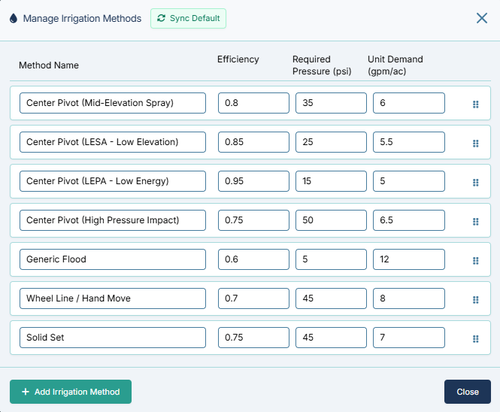
For each system, you must define three critical engineering constraints:
- Efficiency: This is a decimal representing the uniformity and evaporative losses of the system. For example, an efficiency of
0.75means that if the crop physically requires 1 inch of water, the simulation engine will demand 1.33 inches from the pipe network to compensate for losses. - Required Pressure (psi): This is the strict minimum operating pressure. If the hydraulic solver calculates that the pressure at the field's delivery node has dropped below this value (e.g., 35 psi for a mid-elevation pivot), the sprinklers physically cannot function properly. The engine will instantly force the field to shut OFF and abandon its irrigation cycle.
- Unit Demand (gpm/ac): This defines the maximum physical capacity of the system's nozzles or emitters per acre. The engine calculates the total physical flow limit for the field by multiplying this number by the field's acreage. Even if the crop is severely stressed, the system cannot pull more water per hour than this physical hardware limit allows.
Applying a Method to a Field
Once your methods are defined in the library:
- Click on any Agricultural Area (polygon) on your map.
- In the Properties Panel, locate the Irrigation Method dropdown.
- Select your desired system. The field will immediately inherit these strict hydraulic and physical constraints, acting as a unified "delivery block" in the simulation.