Land Use Catalogs
When you draw a municipal zone on the map, the engine needs to know how to calculate its water demand. Instead of manually typing in the required flow for every single neighborhood, IAMDD allows you to build templates in the Municipal Land Use Catalogs.
To manage these templates, open the Library Menu and select Residential Types, Commercial Types, or Industrial Types.
Residential Land Use
Residential demand is highly variable because it mixes constant indoor use with massive, weather-driven outdoor sprinkler use.
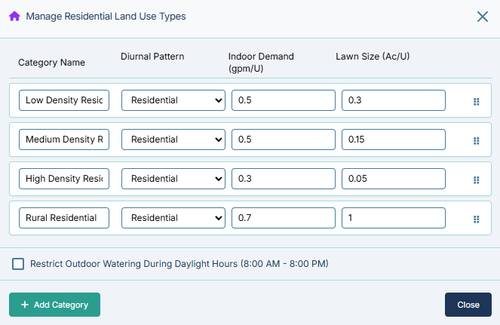
For each residential category (e.g., High Density vs. Rural), you define:
- Diurnal Pattern: The 24-hour multiplier curve applied to this zone (typically a "Residential" pattern with morning and evening peaks).
- Indoor Demand (gpm/U): The baseline indoor flow rate per housing unit.
- Lawn Size (Ac/U): The average size of the irrigable lawn per housing unit. The engine automatically treats this acreage as a "Residential Lawn" crop, tracking its soil moisture and applying a standard 0.20 in/hr sprinkler efficiency to calculate dynamic outdoor demand.
- Daylight Restriction: You can globally force all residential lawns to shut off their sprinklers between 8:00 AM and 8:00 PM to simulate municipal conservation ordinances.
Commercial Land Use
Commercial zones (like strip malls or schools) also have mixed indoor and outdoor demands, but they are typically calculated as a single bulk parcel rather than per-housing-unit.
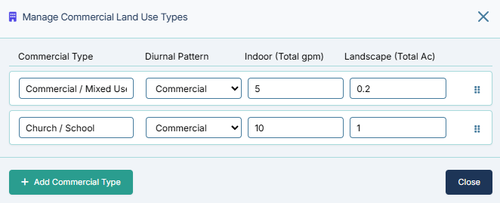
- Indoor (Total gpm): The baseline flow required for the buildings.
- Landscape (Total Ac): The total irrigable landscaping area for the parcel. Similar to residential, this area dynamically reacts to live weather data.
Industrial Land Use
Industrial zones are treated as pure hydraulic consumers. Because heavy industry demand is typically driven by manufacturing processes or cooling towers rather than weather-dependent landscaping, it does not calculate outdoor soil moisture.
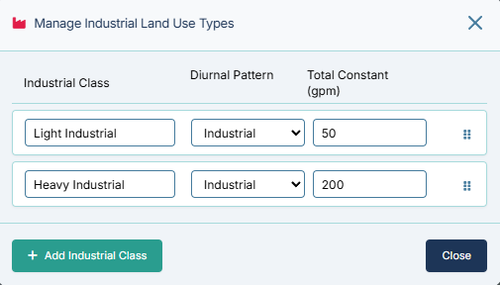
- Total Constant (gpm): The baseline flow required by the industrial facility.
- Diurnal Pattern: The pattern applied to the constant flow (e.g., an "Industrial" pattern that remains high and flat for a standard 8-hour shift, then drops to zero overnight).